
What Tantra Is, and What It Isn't
A note from a lineage-based practitioner of Sri Vidya Tantra
As a lineage-based practitioner of the Sri Vidya Tantra tradition, I often find myself in deep observation of the way Tantra is interpreted in popular culture. I'm not writing this from a place of authority or superiority. I'm writing it as a kind of homage — to the lineage that has carried me for over a decade, through life transitions, through addiction, through moments of real adversity. The integrity of this tradition has been a guiding light. It continues to be the thing that carries me forward on my own path.
So when I see Tantra equated with sex on Instagram — or marketed as a weekend workshop on sacred sexuality, or rendered as a synonym for tantric massage — something in me stirs. Not as offense, exactly. More like a quiet responsibility to speak.
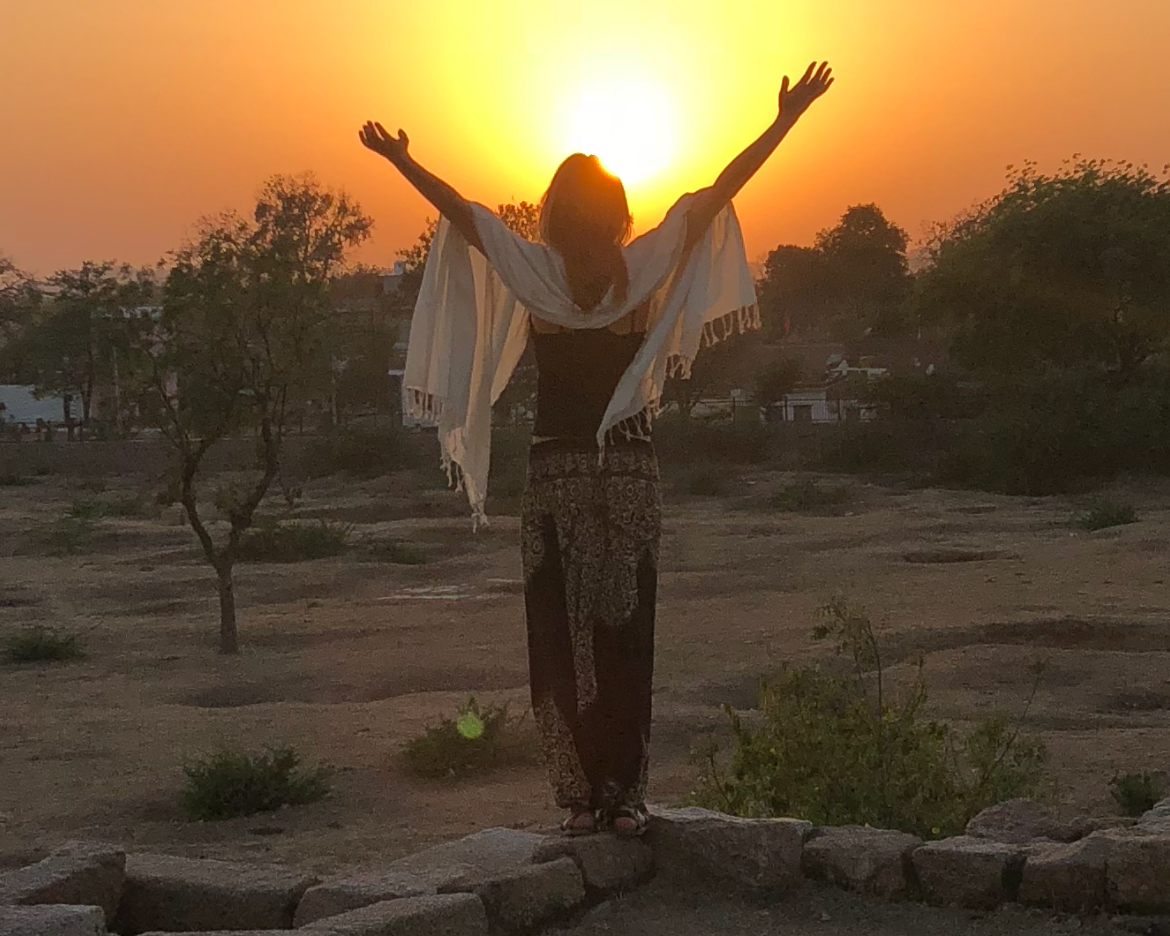
Standing at the Chausath Yogini Temple in Khajuraho — a 9th-century ruin dedicated to the 64 fierce emanations of the Goddess. The temple no longer functions as a place of active worship, but the lineage it served continues elsewhere.
Oral traditions exist for a reason
Wisdom teachings and sacred technologies passed from teacher to student through oral transmission leave very little room for misinterpretation of the lineage itself. The transmission is alive. It happens in the same room. It happens over years. It happens in a relationship of trust and refinement, where what is being passed on isn't only information but a way of being, a quality of attention, a method that can only be learned by doing it under the eye of someone who has done it before you.
This is part of why Tantra has been so easily distorted in its translation to the West. Lineage-based practice is not transferable through a paragraph, a workshop, or a book. It cannot be downloaded. The structure that protected the teaching for thousands of years — direct transmission, sustained relationship, embodied practice — is the very structure that gets stripped away when Tantra is repackaged for a Western audience seeking something faster, more sensational, easier to consume.
There is a line in the Yoga Sutras of Patanjali — the foundational text of classical yoga — that names a particular kind of confusion. It calls it fancy: following after word-knowledge empty of substance. Reading it, I felt the recognition in my body. So much of what circulates as "Tantra" in the West is exactly this. The word, divorced from the substance it points to. The vocabulary, without the practice. Patanjali names this state plainly — wrong knowledge, he calls it. False, illusory, erroneous belief. He names it because he understood, as the lineage has always understood, that this kind of confusion is one of the central obstacles on the path.
What the word "Tantra" actually points to
Classical Tantra is a vast, sophisticated body of philosophy and practice that originated in India. It is non-dual at its root — meaning it holds that the entirety of human experience, including the body, the senses, and the material world, is not separate from the sacred. It works through specific methodologies: mantra (sacred sound), yantra (sacred geometry), ritual, deity practice, meditation, and the careful cultivation of awareness through the subtle body. Sri Vidya, the tradition I practice within, is one of the most refined and rigorous of these lineages. It centers the Goddess — Tripura Sundari — as the ultimate reality, and its practice is, above all, a discipline of attention.
Sex is not the center of this tradition. In some advanced and rarely transmitted classical practices, sexuality appears as a ritual element — but it is symbolic, highly contextualized, and embedded in years of preparation. To pluck this thread out and call it "Tantra" is like pulling a single instrument out of a symphony and calling it the music.
The Kama Sutra is not a Tantric text
Here is where another, related confusion lives. The Kama Sutra is often spoken of in the same breath as Tantra, as though they belong to the same body of teaching. They do not.
The Kama Sutra was composed by the sage Vatsyayana, likely between the 3rd and 5th centuries CE. It belongs to a category of texts called Kama Shastra — the "discipline of kama," meaning the discipline of pleasure, desire, and aesthetic life. In classical Hindu philosophy, human life is oriented around four legitimate aims, the purusharthas: dharma, artha, kama, and moksha.
I want to slow down here, because the Western reception of this text has flattened each of these terms past recognition.
Dharma, as Wendy Doniger writes in her introduction to the Oxford translation of the Kama Sutra, "includes duty, religion, religious merit, morality, social obligations, the law, justice, and so forth." It is the moral and ethical structure of a life — what one is called to do, what one owes, what one is responsible for. Artha is livelihood, material wellbeing, the means of supporting an honorable life. Moksha is liberation. And kama — the term that has been so thoroughly collapsed into "sex" in the West — refers, in Doniger's words, to "pleasure and desire, not merely sexual but more broadly sensual — music, good food, perfume, and so forth." Kama is the entire domain of aesthetic and sensual life. Sex is one element within it.
What is more striking still is that Vatsyayana himself orders these aims hierarchically. In verse 1.2.14, he writes that when dharma, artha, and kama compete with one another, each is more important than the one that follows. Dharma comes first. Artha second. Kama — pleasure — last. The text is not an argument for pleasure as a supreme value. It is an argument for pleasure as a legitimate but subordinate aim within an ethical life.
Vatsyayana goes further. He writes of the practitioner who pursues kama "in chastity and in the highest meditation" — a phrase that, when I read it, stopped me. The text the West has rendered as a sex manual contains, in its own pages, an image of pleasure pursued in the context of celibacy and contemplative discipline. This is not an aside. This is the frame.
The full text covers courtship, the cultivation of the sixty-four arts, the life of a refined citizen, marriage, family, the management of households, and yes, in one portion, sexual practice. It is, in its own structure, a guide to virtuous and gracious living within the domain of pleasure. The sexual chapters are part of a much larger architecture concerned with how a person becomes capable of love, beauty, and refined social life.
It also has nothing methodological to do with Tantra. Kama Shastra and Tantra are distinct bodies of teaching, with different aims, different methods, and different lineages. What happened in the West — particularly through the colonial-era translation of Sir Richard Burton in 1883, and later the Western sexual revolution of the 1960s and 70s — is that a small portion of the Kama Sutra (the sexual portion) was extracted, fused with fragments of Tantric language, and packaged as a single thing called "Tantra." This new thing, which scholars now call neo-Tantra, draws its visual and rhetorical material from classical Tantra but its actual content from a Western therapeutic culture interested in sacred sexuality, intimacy, and personal growth. The term itself was popularized in the 1970s, in part through the teachings of Osho, and it has continued to expand under that name ever since.
Neo-Tantra is its own modern phenomenon, with its own teachers and its own audience. But it is not classical Tantra. It is not Sri Vidya. And the persistent conflation of the two has done real harm — both to the lineage, and to people seeking something deeper who instead encounter a sexualized surface and assume that's what's there.
Satya — the discipline of speaking truthfully
In the yogic tradition, satya is one of the foundational practices: truth in speech, in thought, in action. It appears as the second of the yamas, the ethical restraints, in Patanjali's Yoga Sutras, and the sages have preserved it for thousands of years not as a moral platitude but as a method. To speak the truth — when it is more true than you could even imagine — can make the body tremble. That trembling is the remembrance. It is the body's recognition of something sacred passing through it.
Patanjali says something about satya that I find worth dwelling on. When one is firmly established in speaking truth, he writes, the fruits of action become subservient. All jewels approach the one who is confirmed in honesty. He is not promising material reward. He is naming what happens to a life that has become aligned with what is true: the world begins to meet that life on its own terms.
I take satya seriously. It is part of why I am writing this. Dharma, in Doniger's full sense — duty, religion, religious merit, morality, social obligation — is the structure within which I live as a practitioner. To speak truthfully about the lineage that has carried me is dharmic. It is what is asked. Not to correct anyone publicly, not to position myself against any teacher or tradition, but because I am in a relationship with a lineage that has held me, and the integrity of that relationship has its own claims.
What this means for practice
Sri Vidya Tantra is not intellectual. It cannot be understood through theory alone. Its wisdom reveals itself only through intimate practice with the techniques and methodologies themselves — and ideally, in relationship with a teacher who has been shaped by them. This is not gatekeeping. It is the actual nature of the teaching.
If you are drawn to Tantra, what I would offer is this: be slow. Be discerning. Notice when "Tantra" is being used as a marketing word and when it is being used as a doorway to a real and demanding tradition. The two have become hard to tell apart. But the felt sense is different. Real lineage practice is gentle and rigorous. It does not promise transformation in a weekend. It does not promise enhanced anything. It offers a method, and the method asks for your time.
The trembling I mentioned earlier — the body's recognition of truth — is also how the lineage moves. It moves through people who have agreed to be quiet enough to hear it, and steady enough to carry it. I am one of those people, in my small way. And this little piece of writing is part of how I carry it forward.
Further reading on classical Tantra and its Western reception: Hugh Urban, Tantra: Sex, Secrecy, Politics, and Power in the Study of Religion (University of California Press, 2003); Wendy Doniger, The Mare's Trap: Nature and Culture in the Kamasutra (Speaking Tiger, 2015); Douglas Renfrew Brooks, The Secret of the Three Cities: An Introduction to Hindu Sakta Tantrism (University of Chicago Press, 1990).
