
The Call of the Sacred
I wake up this Sunday morning with my bedroom window open to hear the beautiful sound of bells clanging, jingling, and ringing in the distance.
I live kitty-corner to a Russian Orthodox church, which I have walked past many times and felt the great devotion that lives there. Until this morning, hearing the bells on Sunday mornings, my mind made the assumption that these bells were coming from a Hindu celebration. In my own heart, I remember the specific and particular sound of the ring of the bells within the living Shiva temple in Khajuraho, India — a place that planted a seed in my heart that continues to sprout more and more each day.
And what I noticed this morning was the direction the sound was coming from.
It was coming from the Russian Orthodox Church.
I am not religious. But what I remember on this beautiful morning is that so many people, so many traditions, so many ways of living in a devotional way include something so incredibly universal.
Sound.
The ring of the bells from the Russian Orthodox Church called to my own heart. I lean against my window, close my eyes, and enjoy the sound of devotion ringing so far beyond the walls of their house of devotion that I too can enjoy the call of the sacred.
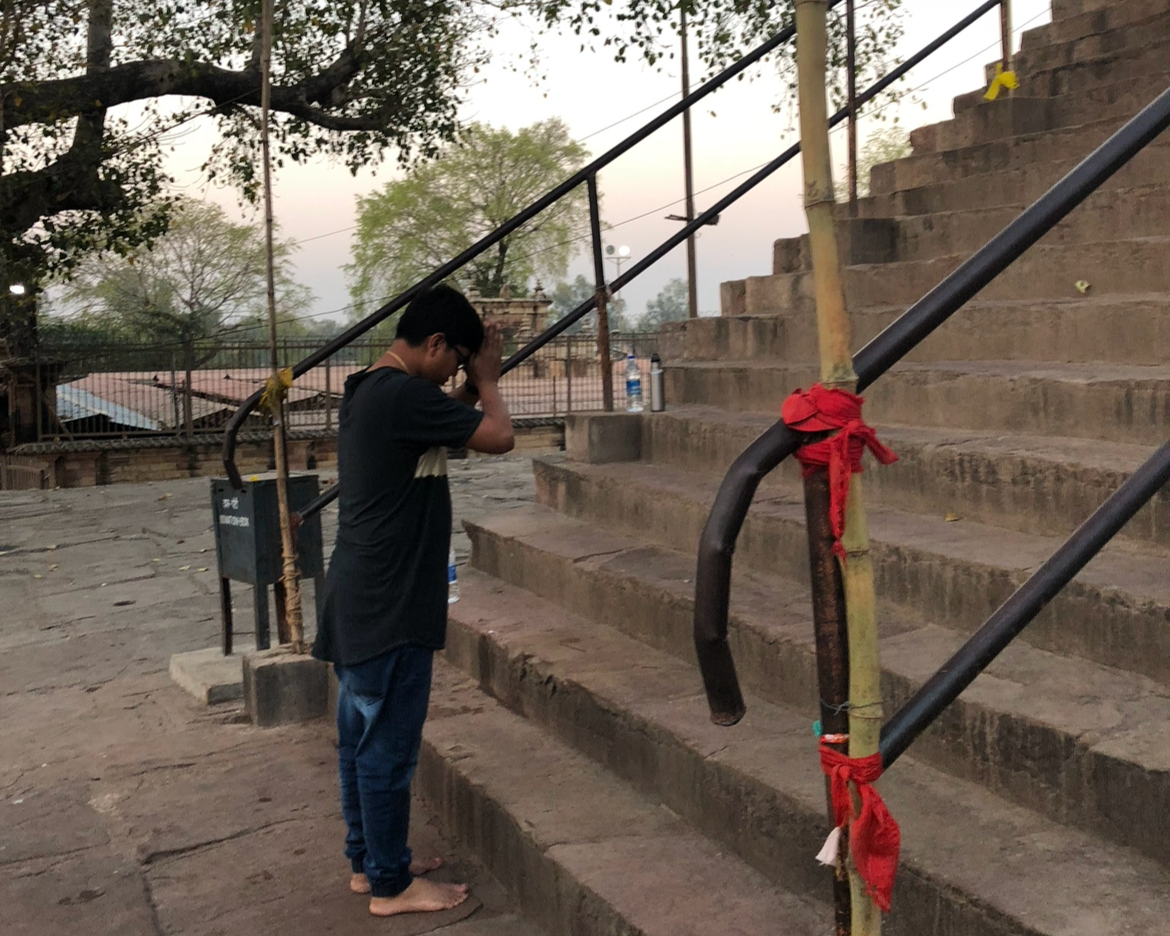
Khajuraho, Madhya Pradesh — March 2017
There is something worth noticing in this.
It is not a coincidence that nearly every contemplative tradition in human history has organized itself around sound. Bells in Russian Orthodox churches. Conch shells and bells in Hindu and Tantric temples. The adhan from the minaret. The shofar. The throat-singing of Tibetan monastics. Gregorian chant. The mantra of the Sri Vidya tradition I have spent the last decade of my life inside.
These are not aesthetic choices. They are technologies.
Different cultures, different cosmologies, different theologies — all converging on the same observation: that sound does something to a human being that silence alone does not. That a particular kind of vibration, repeated, can bring a mind that is scattered into a state that is gathered. That something in the nervous system listens before the thinking mind ever has a chance to interpret.
The bells outside my window this morning were not asking me to convert to anything. They were doing what bells do. They were calling.
In Classical Tantra, the practice of mantra is not symbolic. It is not a metaphor for prayer, and it is not the recitation of words whose meaning matters most.
Mantra is sound used as a contemplative tool — a deliberate vibration that gives the mind something to rest on. The Sanskrit roots are manas (mind) and tra (instrument, tool, that which protects). Mantra is, quite literally, an instrument of mind. A tool used to steady something that does not want to be still.
When you sit and repeat a mantra, you are not asking for something. You are not performing devotion. You are giving your attention a shape to return to. Each time the mind wanders — and it will wander, hundreds of times in a single sitting — the sound is there to come back to. Not as a punishment for wandering, but as a place to land.
This is not a beginner's practice. It is one of the most sophisticated technologies of attention humans have ever developed. And it has been refined, in living lineages, for thousands of years.
What modern science has begun to demonstrate is why this works at the level of the body.
In 2001, a team of researchers led by Luciano Bernardi published a study in the British Medical Journal comparing two practices: the recitation of the Ave Maria in Latin, and the recitation of the Buddhist mantra Om Mani Padme Hum. The researchers were not looking for a spiritual phenomenon. They were measuring respiration, heart rate variability, and baroreflex sensitivity — the body's basic capacity to regulate itself in response to stress.
What they found was that both practices, despite emerging from entirely different traditions in entirely different parts of the world, slowed the breath to almost exactly six breaths per minute. And at that rate, the body did something remarkable: cardiovascular rhythms came into coherence with the breath, heart rate variability increased, and the autonomic nervous system shifted measurably toward a state of regulated calm. (Bernardi et al., 2001, BMJ)
Two traditions. Same physiological signature. The Catholic monks who developed the rosary and the Indian yogis who developed mantra were not in conversation with each other. They had stumbled onto the same technology by paying attention to what worked.
More recent research has examined the specific effects of Om chanting on heart rate variability and vagal tone — the responsiveness of the parasympathetic nervous system, which governs rest, digestion, and recovery. Studies have shown that chanting produces measurable increases in markers of vagal activity, with experienced practitioners showing greater baseline regulation than novices. (Inbaraj et al., 2022)
The conclusion is not mystical. It is embodied. Slow, sustained, vocalized sound — produced in the body and felt as vibration in the throat and chest — works directly on the systems of the body that determine whether you feel calm or activated, present or scattered, regulated or reactive.
This is why every tradition stumbled onto it. They did not have the language of vagal tone or heart rate variability or baroreflex sensitivity. They had the experience: that something happens when you sing in the body of a chapel, when you chant in the body of a temple, when you repeat a sound until the sound is repeating you.
What they were doing was nervous system regulation. Sacred nervous system regulation.
Back to the window.
The reason the bells called to me this morning is the same reason they call to anyone who hears them. The body recognizes coherent vibration before the mind interprets where it is coming from or what it means. There is something in the human nervous system that responds to ordered sound the way a tuning fork responds to its match — it begins, quietly, to come into resonance.
I did not need to be Russian, or Orthodox, or religious in any sense to feel what I felt at the window. I needed only to be a body. The sound did the rest.
This is the universal beneath the particular. Not that all traditions are the same — they are not, and the differences matter — but that the human nervous system has always been the same nervous system, and humans have always been finding their way home to it through some version of organized sound.
In the eight-week meditation training I teach, we spend an entire week on sound. Mantra is the fifth movement of the curriculum, after we have already worked with thoughts, the architecture of the mind, the body as doorway, and the breath as bridge.
By the time we arrive at sound, the body is ready for it.
We do not start with mantra because mantra requires somewhere to land. It requires a body that has already practiced steadiness in posture, an attention that has already learned to rest on the breath, a mind that has already begun to recognize its own activity without being consumed by it. Mantra is not the first tool. It is one of the most refined.
When students arrive at the sound week of the cohort, what they often discover is that they have been hearing devotion their whole lives without recognizing it. The hum of an old refrigerator. The repetition of their own footsteps on a familiar walk. The bells of a church they pass without thinking. Once you have begun to practice, the world becomes audible in a different way. The ordinary becomes a doorway.
This is not because anything outside has changed. It is because something in the listener has steadied enough to receive what was always there.
The next 8-week meditation training begins Saturday, June 20th. We meet weekly online, 10:00 AM Pacific / 1:00 PM Eastern, for 75 minutes.
The waitlist is open. If you are reading this, and the bells called to something in you, you can sign up at steadyselfschool.com/meditation-training.
The cohort is small by design. A handful of people. Eight weeks. A real curriculum.
That is the invitation.
— Julia
References
Bernardi, L., Sleight, P., Bandinelli, G., Cencetti, S., Fattorini, L., Wdowczyc-Szulc, J., & Lagi, A. (2001). Effect of rosary prayer and yoga mantras on autonomic cardiovascular rhythms: comparative study. BMJ, 323(7327), 1446–1449. Full text
Inbaraj, G., Rao, R. M., Ram, A., Bayari, S. K., Belur, S., Prathyusha, P. V., Sathyaprabha, T. N., & Udupa, K. (2022). Immediate Effects of OM Chanting on Heart Rate Variability Measures Compared Between Experienced and Inexperienced Yoga Practitioners. International Journal of Yoga, 15(1), 52–58. Full text
